
Different from the others
On Leontine Sagan's Mädchen in Uniform and lending clothes

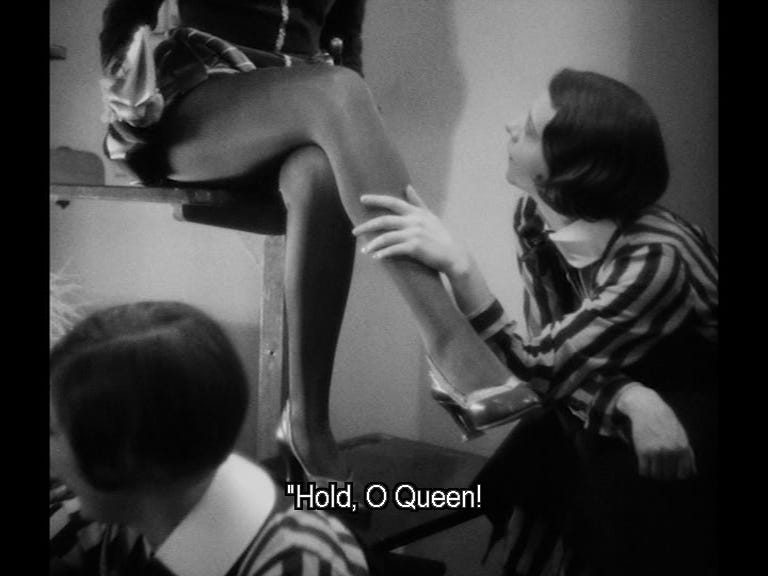
I had planned to write about a film I love, Joseph Losey’s Eva. But I was thinking about films I hadn’t yet seen that I might want to teach next year and I found myself at last unwrapping a blu ray of Leontine Sagan’s Mädchen in Uniform (1931). This film is a far more fitting companion piece to Picnic at Hanging Rock, with its girls school setting, but Mädchen is far more overt in its queerness. Reading some of the material included with the BFI release of film, I found that it was remarkable for being Sagan’s first film as a director, and that it has remained something of a curiosity for its overt display and acknowledgment of sapphic desire.
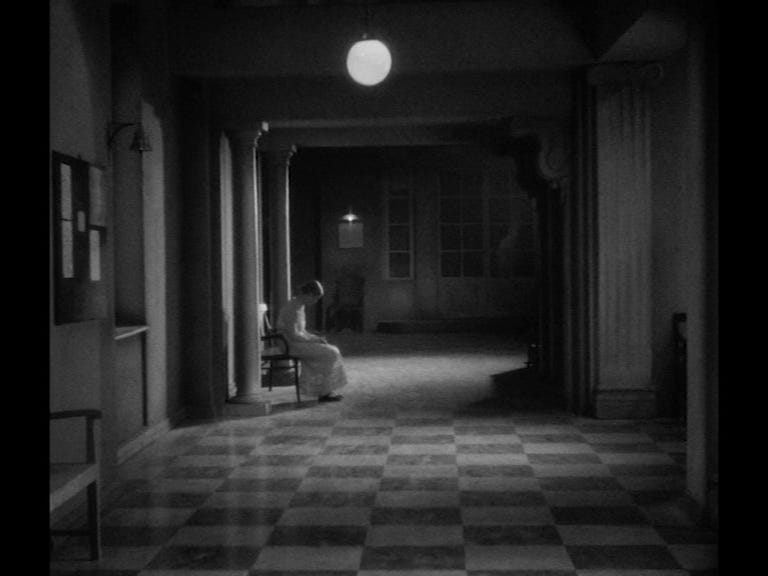
Where Sara in Hanging Rock is increasingly isolated and forgotten by her peers, Manuela (Herthe Thiele) is idolised and supported by her peers in a way that is deeply moving. In Mädchen, Manuela is the gleaming blonde student, and the object of her crush is the shining brunette teacher Fräulein von Bernberg (Dorothea Wieck).


There is much in this film that is astonishingly playful and beautiful. Made in the waning days of the permissive Weimar Republic, Mädchen is a film about hunger: for lavish food, for touch, and for desire. Set within the confines of a strict boarding school, the pupils are being groomed to be the mothers of soldiers by their rather terrifying headmistress, a woman wedded to a particularly rigid Prussian aesthetic that believes in denial and starvation.


Nevertheless, the girls have rich fantasy lives, showing off collages of film stars, magazines with photographs of athletes, and revelling in the permissions accorded by the school play. All the girls speak about food: their favourite desserts, or even whether one’s mother might send a ham in the post. When a letter describing the students’ undernourishment is intercepted, it is cause for scandal, but this is nothing compared with Manuela’s open longing for kisses and embraces from Fräulein von Bernberg. Just as Hanging Rock places importance on clothing as revelatory (the scrap of lace that heralds Irma’s discovery on the rock, or the handing over of Miranda’s underclothes to the police), Mädchen shows us Manuela recieving the gift of a nightgown from Fräulein von Bernberg. At each offering of affection or care, Manuela becomes ever more devoted, blurring the lines between a motherless young woman, and the young woman charged with her care. While there is a power imbalance in this relationship, it is hard to ignore the fact that Thiele and Wieck are the same age, and this shifts their expressions of love and desire into a realm that registers as openly queer.
Unlike the obsessive display of clothing on offer in something like Hitchcock’s Rebecca, where Mrs Danvers lovingly preserves the dead Mrs DeWinter’s handmade lingerie, the offering of the nightgown in Mädchen in Uniform is more in the spirit of the shirt that Elio asks Oliver to give to him in Call Me By Your Name. In Call Me By Your Name, the shirt is used to clean up after sex, and later it is washed and worn loosely and louchely by Elio.
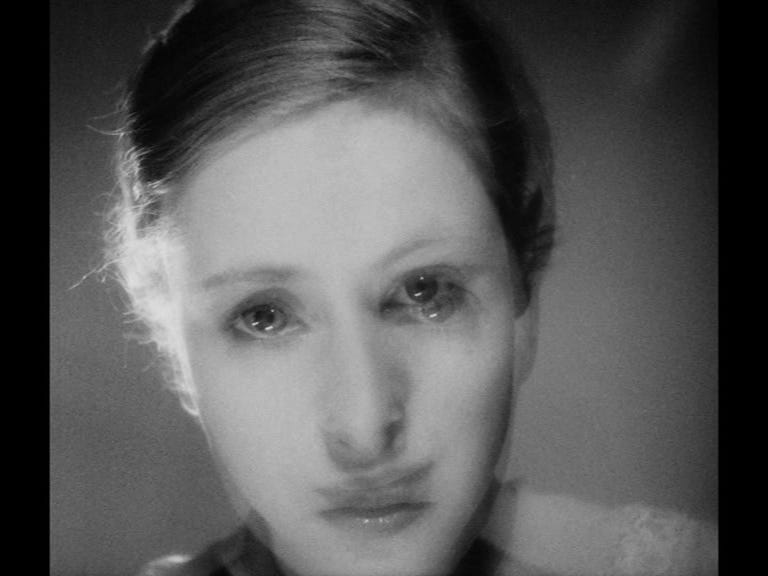
Many years ago, I lent a friend one of my t-shirts to wear on an impromptu night out. I liked that he gladly wore this obscenely tight, pale grey t-shirt that was certainly not the fashion for men at this period, but it was something that he carried off with characteristic insouciance. More recently, I lent a friend a white, cellular cotton v-neck t-shirt. While I wear this t-shirt loosely, it fit him perfectly, and I considered whether I ought to offer it to him as a gift. I have also asked to keep jewellery worn by a friend in the 90s, as a memento of that period in our lives. There are certain perfumes (Karma by Lush, CK One, Trésor by Lancôme) that hit me where I live, and when I smell them I am there and here at the same time. That feeling of connection is also shown to us in Mädchen in Uniform, in the remarkable moment where the face of Fräulein von Bernberg dissolves into that of Manuela, suggesting a dreamlike, psychic bond. We might imagine that Manuela treasures not just the nightgown, but the aroma of the wardrobe from which it has come. I like to think some of those aromas might be contained in something like Urania’s Queer Magic, with cardamom, palo santo, and tobacco leaf, as if the clothing were filled with stolen, secret things, pilfered from the school kitchen or gardens, to create a hidden pleasure that she longs to share with someone else.
Your post recalls to mind two things for me: the Louise Brooks film, Diary of a Lost Girl and smelling a very old vintage version of the perfume, Bandit.