
Come to 'daddy': notes on Hellraisers
Not so much ‘is the rectum a grave?’ as ‘what does the fuck dungeon smell like?’

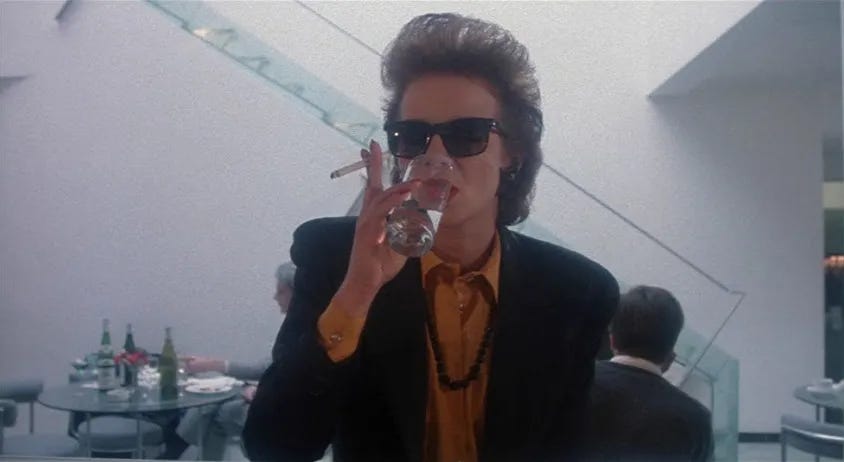
Hellraiser (1987) opens with the smell of sweet tea, dust, and whatever is under those dirty fingernails (Dirt? Blood? Opium shavings?) This is followed by sweat, candle wax, and flesh. Much like Ken Russell’s The Devils, Hellraiser is SWEATY. A cockroach emerging from the fold of sheets heralds a deep-seated filth inside the derelict house. The torturous hell dimension with its hooks and gore would smell like a butcher shop, cold steel, and the leather of the cenobites’ garments would be lived in, next to the skin.
When Julia enters the house she sniffs, “it smells damp” meaning it smells like mould. Later, she puts her cigarette out on the floor. The kitchen is a mass of garbage, maggots, and rot, though no one seems especially shocked or surprised by this level of filth.
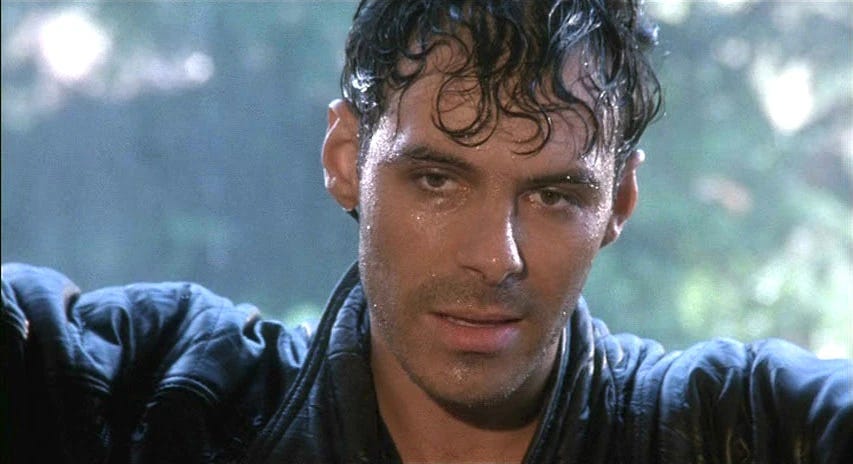
Julia’s flashback to meeting Frank for the first time is also filth of a different order: he appears unexpectedly and rain drenched, as if from the cover of a cheap romance novel, smelling of worn-in motorcycle leather and petrichor, already a sybarite. He doesn’t so much kiss Julia as devour her, and when he cuts the ribbon straps of her white, bridal lingerie with a switchblade it establishes Frank as a force for erotic chaos. Julia is helplessly in thrall to him, vowing she will do anything he wants.
(Other forces for erotic chaos include: Oliver Reed in The Devils AND The Brood, Franz Rogowski in Passages, Uma Thurman in Henry and June, and Michelle Pfeiffer as Catwoman. The S2 Hannibal episode ‘Naka choko’ also exists in this heady, sexually unhinged atmosphere)
We hear the phrase “come to daddy” a lot in this movie. Frank says it to Julia (kinkily) and to Kirsty (creepily), but I would like to put forward another case for who is ‘daddy’ here: Julia in her black power suit picking up random dudes, then hitting them with a hammer is definitely daddy energy. As the film progresses, there are multiple shots of Julia looking at herself in the mirror, at where blood has smeared on her flesh. We imagine her smelling of hair mousse, the tang of blood, lipstick, and probably Nikki de Saint Phalle or Dior’s Poison, launched in 1985 and repped by the glorious Isabelle Adjani. Dior’s website describes this fragrance as “the ultimate fragrant weapon of heightened seduction.” There is an apocryphal anecdote about Poison being banned from certain restaurants in the 1980s because the small was so strong and divisive, and that it is scent with qualities that “defy gender.” Perhaps this divisiveness comes from its scents of coriander, tuberose, and myrrh: strong, opinionated, a fragrant weapon indeed.
“Franks says “The cenobites gave me an experience beyond limits. Pain and pleasure indivisible” but pain and pleasure are constantly intertwined here, with Julia’s erotic reveries of Frank intercut with Larry’s hand being wounded, and the lit cigarette Kirsty’s boyfriend flips in and out of his mouth.
There is something distinctly Sadeian about the cenobites and the world of Hellraiser, though only in Angela Carter’s sense, where she makes de Sade her bitch in The Sadeian Woman:“it is a wonder anyone in this culture learns how to fuck at all.” (1979: 11) Perhaps this is also the appeal of the Hellraisers—a realm where sensation rules, where learning to fuck is just the beginning.

In Hellraiser (2022), everyone is really hot and I respect that. (Hiam Abbas, the actor who plays Serena is 61? Like, damn). Joey (Kit Clarke), the pretty first victim seemingly bewildered but intrigued by the Eyes Wide Shut-orgy-of-the-wealthy he’s wandered into, whose screams of pain shift directly into Riley and Trevor (Drew Starkey) vigourously fucking, sets the tone; that and the fact that this sex scene is shot at an angle one would not have seen prior to the era of amateur porn shot on a smartphone. Riley smells of American Spirit cigarettes and patchouli. Trevor just smells freshly showered and DTF and both these films want us to be suspicious of men who are a little too objectively hot.


The public bathroom as a site of inter-dimensional horror? I’m sure there is a Foucauldian reading there somewhere, along with a Candyman reference. The blood in the sink, antibacterial cleaning products, bleach, and what your worst hoodie smells like when it gets wet.


There is nothing new about a creepy hospital setting, but the way this Hellraiser presents the constrained sound of breath, choked or yanked out of the body, and those distorted cenobite voices feels very much like exactly the kind of horror one would make having experienced a respiratory virus pandemic. It is constrained breath that characterises some of the most chilling appearances of the cenobites, reinforcing how much the gasp, the rasp, and the moan are the sounds of the body in distress, even more than a scream. Hellraiser (2022) trades in the duality of the sound of breath: that it contains ecstasy and fear, that it’s close to the flesh, intimate, unique.

I wonder if there is a case to be made here about how the neglected mansions of the super-rich could be occupied by new kinship configurations, therefore making the fuck dungeon some kind of alternative to current/dominant societal structures. Is the fuck dungeon a possible utopia? Perhaps. Though not this particular fuck dungeon, which smells like the hell dimension, like a cenobite’s nest, like a leather jockstrap and vintage porn mags.
“There is so much more the body can be made to feel”: a truly visceral shiver at that line. Though the cenobites promise that “greater delights await” we know this is a trap. I like horror that walks that line, suggesting that total knowledge is impossible or terrifying and that bodies are perilous. In this Hellraiser, the greatest gift is to become a cenobite, someone who has transcended this realm’s concepts of both pain and beauty. Anyone who has ever been tattooed or pierced, worn a corset or a harness, has touched this feeling if only briefly. Dancers and other athletes also know what it means to test your body’s thresholds, that you can train the body to be more flexible, to withstand certain sensations and counteract your initial impulses. And of course, horror, in its plots, its effects and its affects, has long been concerned with thresholds, and their dissolution. In the first Hellraiser, there are so many fluids: blood, lymph, vomit, pus, grime, saliva, the very landscape of the body’s physical barriers. But these Hellraisers are terrifying not only because of the ways in which the cenobites have been mutilated, but because they suggest a realm where it is possible to know and to feel everything, and remain unsatisfied, “enough is a myth,” declares Pinhead (Jamie Clayton). This level of knowledge and feeling is unbearable and yet also signals a permanent state of longing. Horror like this reminds me of what Angela Carter writes of her young protagonist in The Company of Wolves: “she does not know how to shiver.” Every time we watch a horror film we hope to know that innocence again, and find something that will show us how to shiver.
My god this is good. Some of the smartest writing on Substack.
You are both being far too kind about my writing 💖